


















































































Kenya’s $62 Billion Mineral wealth attracts US mining consortium


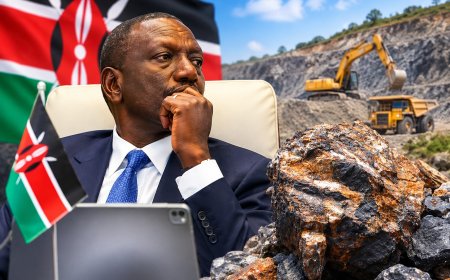
A US-led consortium has been selected to develop one of Kenya’s most promising critical-minerals deposits, in a move that strengthens Washington’s efforts to secure strategic resources in Africa and reduce its dependence on China.
Kenya’s Ministry of Mining, Blue Economy and Maritime Affairs announced on Thursday, November 19, that Frontier Minerals Consortium had been selected for the Mrima Hill niobium and rare earths project in Kwale County, southeastern Kenya.
The consortium brings together Frontier Minerals LLC, Bunker Hill Mining Corporation, American Resources Corporation and ReElement Technologies Corporation.
It emerged successful in a competitive tender involving several international bidders, including companies backed by Australian and American investors.
Preliminary assessments suggest that Mrima Hill could contain mineral resources worth more than $60 billion, including rare earth elements and niobium, a metal used in aerospace manufacturing, electric vehicles, electronics and defence technologies.
The development represents a significant opportunity for Kenya to strengthen its position in the global critical-minerals market.
Frontier Minerals has pledged to establish mineral processing and refining facilities within the country, allowing Kenya to capture more economic value instead of exporting raw materials for processing elsewhere.
The award also reflects growing geopolitical competition over Africa’s mineral wealth.
China currently dominates much of the world’s rare-earth processing capacity, making African deposits increasingly important to countries seeking alternative sources of supply.
The United States has intensified its engagement with mineral-rich African countries, including the Democratic Republic of Congo and Zambia.
Its strategic partnership with the DRC, signed in December 2025, focuses partly on critical minerals, investment and infrastructure development.
The Lobito Corridor, connecting mineral-producing regions to Angola’s Atlantic coast, is another major part of Washington’s regional strategy.
However, the Kenyan project faces significant environmental and social challenges.
Mrima Hill contains a forest considered sacred by members of the Digo community, who fear mining could damage ancestral burial sites, traditional heritage and local ecosystems.
Residents have also raised concerns about possible land displacement and whether surrounding communities will receive meaningful economic benefits.
The community members are seeking greater transparency about the proposed development and assurances that their rights and cultural heritage will be protected.
The tender has also attracted controversy. Australian mining company RareX, which partnered with Iluka Resources, says it intends to challenge the award, alleging that Frontier’s expression of interest was submitted after the stipulated deadline.
RareX claims its consortium was the highest-ranked eligible bidder.
Kenya’s government maintains that the procurement process was conducted fairly and transparently.
Importantly, the selection does not automatically authorise commercial mining.
Frontier must still obtain the required prospecting licence and meet environmental, community consultation and other regulatory requirements before development can proceed.
What's Your Reaction?
 Like
0
 Dislike
0
 Love
0
 Funny
0
 Angry
0
 Sad
0
 Wow
0