




































































































Is the UK playing a double game in Sudan and Somalia?

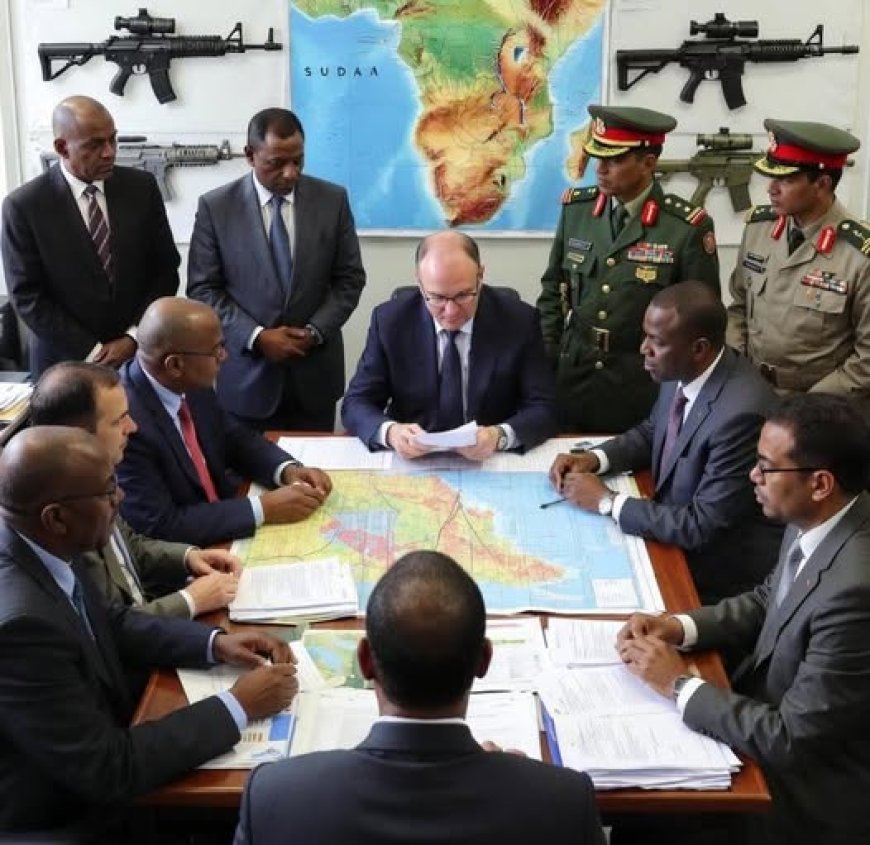
Critics argue that the United Kingdom’s policies in the Horn of Africa are increasingly deepening, rather than easing, regional crises.
While London publicly calls for accountability and stability, analysts say its actions in Sudan and Somalia reveal contradictions that have eroded its credibility and recast it as an actor driven more by strategic interests than by principled diplomacy.
In Sudan, the UK has repeatedly voiced concern over the devastating war between the Sudanese Armed Forces and the Rapid Support Forces (RSF).
British officials have described the conflict as catastrophic, highlighting mass civilian deaths and humanitarian collapse.
However, investigative reporting has revealed that behind closed doors, the UK rejected more assertive proposals aimed at preventing atrocities, opting instead for what internal documents described as the “least ambitious” diplomatic approach as violence escalated.
According to Sudanese policy analyst Amgad Fareid Eltayeb, this posture has shaped how the UK is perceived internationally. Rather than being viewed as disengaged or peripheral, Britain is now seen as a central diplomatic actor whose caution has influenced how the conflict is framed.
He argues that this has contributed to what he calls the “whitewashing” of RSF atrocities, particularly amid allegations that the United Arab Emirates has armed or supported the paramilitary group — claims supported by UN experts and media investigations but denied by Abu Dhabi.
Eltayeb describes the UK as having become “an enabler of Emirati aggression in Sudan,” not through direct involvement, but by avoiding diplomatic pressure that might disrupt key regional partnerships.
He suggests this has damaged Britain’s standing as an honest broker, replacing it with the perception of an “interest manager” unwilling to take political risks to protect civilians.
The UK Foreign Office disputes this characterisation, stating that Britain is working with international partners to secure a ceasefire, ensure humanitarian access, and support a transition to civilian rule.
Nonetheless, analysts say the gap between rhetoric and action has already shaped how Britain’s wider regional policies are interpreted.
This credibility problem extends eastward to Somalia and the breakaway region of Somaliland.
Officially, the UK supports Somalia’s territorial integrity and does not recognise Somaliland’s declaration of independence.
Yet through its development finance institution, British International Investment (BII), the UK co-owns the strategically significant port of Berbera in Somaliland, alongside the UAE-based logistics firm DP World and the Somaliland authorities.
Berbera’s location near vital maritime corridors linking the Red Sea and the Indian Ocean gives it major geopolitical importance.
A UK-commissioned impact assessment has described the port as a strategic gateway and a potential alternative trade route for Ethiopia, language that firmly situates it within the region’s security and influence architecture.
Historians note that Berbera has long been treated by external powers as strategic infrastructure rather than as part of a political community.
Over time, it has served as a British coaling station, a Soviet naval base, and now a commercial logistics hub shaped by Gulf and Western interests.
Critics argue that Britain’s financial stake continues this pattern, prioritising access and influence over political clarity.
Concerns have intensified as Sudan’s war has spilled across borders.
Observers have linked Berbera to a broader Emirati logistics network that UN experts and journalists say may have facilitated arms transfers to the RSF — allegations the UAE denies.
While direct evidence of UK involvement is lacking, analysts argue that Britain’s financial entanglement with UAE-operated infrastructure raises serious perception issues.
Independent analyst Abdalftah Hamed Ali describes this as a “gap between principle and practice.”
Even if London disputes any logistical link to the Sudan conflict, he argues, the perception that it profits from infrastructure tied to a key regional actor accused of backing one side in the war undermines its moral authority.
The issue has become more sensitive as Somaliland’s political status has re-entered diplomatic debate, particularly following Israel’s decision to recognise Somaliland’s independence — a move rejected by Mogadishu and the wider international community.
Analysts say such developments make it increasingly difficult to argue that economic engagement can be separated from politics.
Ports like Berbera, Ali notes, are not neutral assets but nodes within a broader security and influence ecosystem.
Investment in such infrastructure inevitably strengthens the bargaining position of local authorities, reshapes alliances, and draws external actors deeper into unresolved political disputes.
Britain’s approach is often described as “dual-track”: maintaining formal relations with Somalia’s recognised government while working pragmatically with Somaliland as a stable, functioning authority that controls territory.
While this may preserve flexibility, critics warn it carries long-term risks.
According to scholars at the London School of Economics, large-scale external investment can undermine Somaliland’s internal accountability by weakening the historical link between revenue collection and political legitimacy.
When governments rely on foreign capital rather than local bargaining, the fiscal and political contract shifts, potentially eroding democratic checks.
Taken together, analysts argue that Britain’s policies in Sudan and Somalia reflect a single strategic logic: Preserving access, partnerships, and influence while avoiding confrontations that might limit diplomatic manoeuvrability.
While this may secure short-term gains, critics warn it is steadily costing the UK its credibility in one of the world’s most politically entangled regions.
As Ali concludes, in the Horn of Africa, mixed signals are not neutral.
When words and actions diverge, moral authority fades — and with it, the ability to push for genuine political compromise.
What's Your Reaction?
 Like
0
Like
0
 Dislike
0
Dislike
0
 Love
0
Love
0
 Funny
0
Funny
0
 Angry
0
Angry
0
 Sad
0
Sad
0
 Wow
0
Wow
0