



























Uganda: Tooro’s King Oyo buried as succession dispute deepens
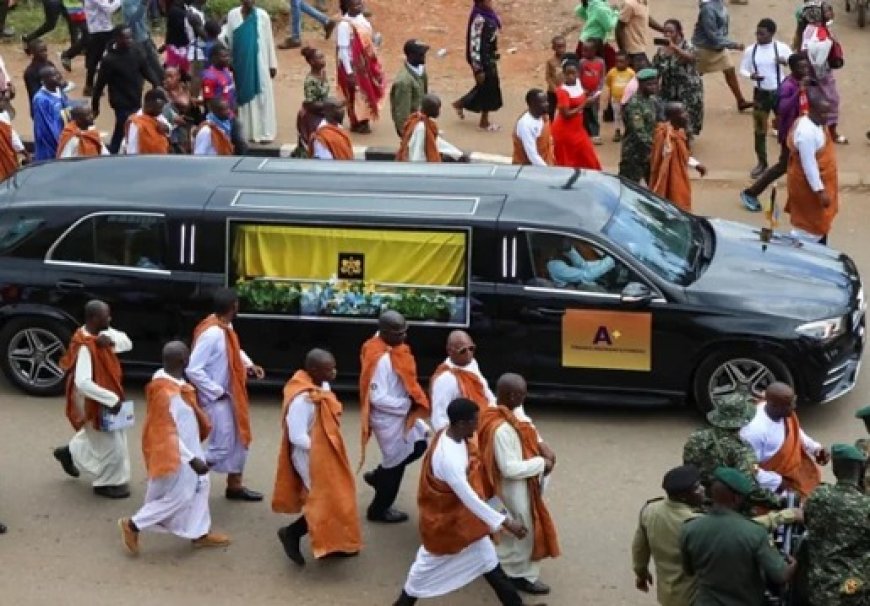
Thousands of mourners gathered in Fort Portal on Saturday to bid farewell to Uganda’s King Oyo Nyimba Kabamba Iguru Rukidi IV, as the Tooro Kingdom buried its late monarch amid an unusual dispute over who should succeed him.
Oyo, 34, died on August 27 in the United States while receiving treatment for cancer.
He was buried at the Karambi Royal Tombs, the traditional resting place of Tooro’s kings, after a funeral service at St John’s Cathedral in Fort Portal.
Large crowds lined the streets as the king’s coffin was taken to the royal tombs.
During the traditional burial ceremony, Prince Edward Rukidi Kijanangoma, a 56-year-old member of the royal family and television presenter, reportedly placed nine coffee berries into the king’s grave.
The ritual symbolised the end of one reign and the beginning of another.
But even as Oyo was being laid to rest, questions remained over who will inherit the throne.
Kijanangoma has been selected by members of the royal clan to succeed Oyo, but the late king’s family has rejected his appointment.
Oyo’s sister, Princess Ruth Nsemere Komuntale, has said her brother left a will in 2022 naming his young son as his heir.
The revelation has added a new dimension to the succession process and created tension between the late king’s family and traditional authorities within Tooro.
Uganda’s Attorney General has reportedly indicated that Oyo’s will should be considered in determining the succession, potentially setting the stage for a legal battle if the competing claims are not resolved.
The dispute is unfolding in one of Uganda’s most historically significant traditional kingdoms.
Tooro, whose capital is Fort Portal in western Uganda, traces its origins to the 19th century.
It was established around 1830 under Omukama Kaboyo Olimi I after breaking away from the larger Bunyoro-Kitara kingdom.
The institution survived colonial rule but was abolished by the Ugandan government in 1967.
Traditional kingdoms were restored in Uganda in 1993 under President Yoweri Museveni, although they were given cultural rather than political authority.
The king, known as the Omukama, does not exercise constitutional or executive power but remains an important cultural and symbolic leader of the Batooro people.
Oyo became king in 1995 at the age of three after the death of his father, King Patrick Matthew Kaboyo Olimi III.
His coronation made him internationally recognised as the world’s youngest reigning monarch.
Over three decades on the throne, Oyo grew from a child monarch into a prominent cultural figure and became involved in initiatives focused on youth empowerment, health and environmental conservation.
His burial marks the end of a historic reign, but the question of who will carry the crown forward leaves the Tooro Kingdom facing a new and uncertain chapter.
What's Your Reaction?
 Like
0
Like
0
 Dislike
0
Dislike
0
 Love
0
Love
0
 Funny
0
Funny
0
 Angry
0
Angry
0
 Sad
0
Sad
0
 Wow
0
Wow
0