





































Hakainde Hichilema re-elected as Zambia’s President
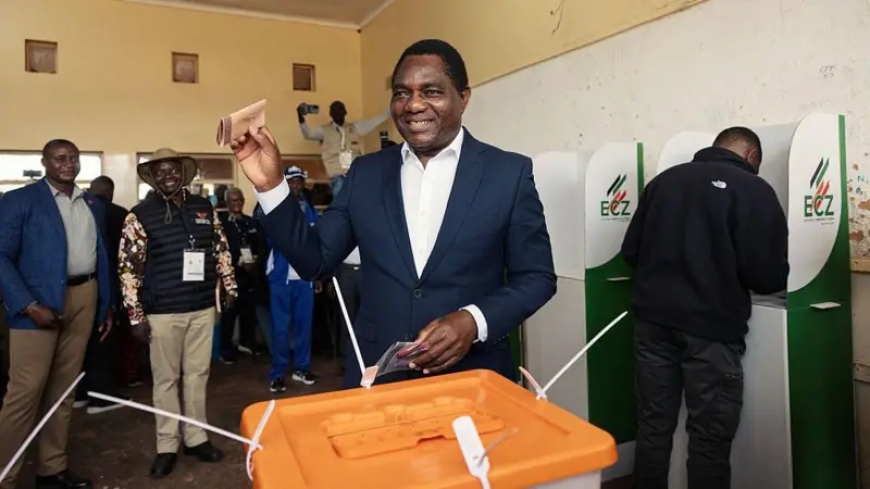
Zambian President Hakainde Hichilema has won a second five-year term after securing more than 60% of the valid votes in the country’s presidential election held on 13 August 2026.
The Electoral Commission of Zambia (ECZ) declared Hichilema, leader of the United Party for National Development (UPND), the winner after completing the counting and verification of results from all 226 constituencies.
He received 2,965,326 votes, or 60.49%, giving him a clear majority over his main challenger, Brian Mundubile of the NRPUP, who obtained 1,856,217 votes, or 37.87%.
Hichilema’s winning margin was 1,109,109 votes, allowing him to avoid a second-round runoff under Zambia’s electoral system, which requires a presidential candidate to obtain more than 50% of valid votes to win outright.
The election was contested by more than 8.7 million registered voters.
The ECZ had certified 8,786,300 voters ahead of polling, with the final register covering 226 constituencies.
The election was not without controversy.
Vote counting was temporarily suspended after incidents involving attacks on election officials and the theft of ballot materials.
Opposition figures also questioned aspects of the electoral process, while Hichilema called for calm and urged Zambians to await the official results.
International observers described the election as largely peaceful but raised concerns about restrictions and an uneven campaign environment.
Hichilema's victory extends his presidency beyond his first term, which began in August 2021 after he defeated then-President Edgar Lungu.
His second term will come with significant economic expectations.
His government has overseen a major restructuring of Zambia’s debt after the country defaulted in 2020, while seeking to attract investment and expand the mining sector, particularly copper.
However, challenges remain. High living costs, electricity shortages and poverty continue to affect many Zambians, putting pressure on the government to ensure that economic recovery translates into better living standards.
Hichilema has also pledged to significantly increase copper production and create more jobs during his second term.
Zambia became independent from Britain on 24 October 1964.
Since then, the country has had seven substantive presidents, with Guy Scott serving briefly as acting president after Michael Sata’s death.
Kenneth Kaunda — 1964–1991, Zambia’s first president and independence leader, Kaunda ruled for 27 years.
Frederick Chiluba — 1991–2002, He defeated Kaunda in the 1991 multiparty election, ending UNIP's long rule.
Levy Mwanawasa — 2002–2008, Mwanawasa led Zambia until his death in office in August 2008.
Rupiah Banda — 2008–2011, He assumed the presidency following Mwanawasa's death and later won the 2008 election.
Michael Sata — 2011–2014, Sata leader of the Patriotic Front, defeated Banda in the 2011 election.
Edgar Lungu — 2015–2021, Lungu became president after winning the 2015 election following Sata's death and was re-elected in 2016.
Hakainde Hichilema — 2021, Hichilema defeated Lungu in 2021 and has now secured a second term after winning the 2026 election.
Guy Scott — 2014–2015, who served as acting president between Michael Sata's death and Edgar Lungu’s inauguration.
What's Your Reaction?
 Like
0
Like
0
 Dislike
0
Dislike
0
 Love
0
Love
0
 Funny
0
Funny
0
 Angry
0
Angry
0
 Sad
0
Sad
0
 Wow
0
Wow
0