










































Former US vice president “Dick Cheney” dies at 84

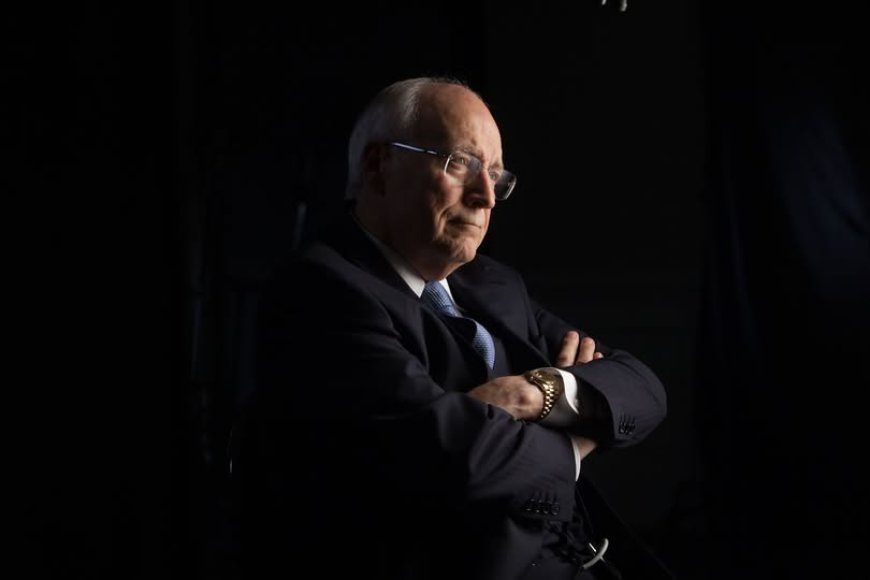
Dick Cheney, the hard-charging conservative who became one of the most powerful and polarizing vice presidents in U.S. history and a leading advocate for the invasion of Iraq, has died at 84.
Cheney died Monday due to complications of pneumonia and cardiac and vascular disease, his family said Tuesday in a statement.
The quietly forceful Cheney served father and son presidents, leading the armed forces as defense chief during the Persian Gulf War under President George H.W. Bush before returning to public life as vice president under Bush’s son George W. Bush.
Cheney was, in effect, the chief operating officer of the younger Bush’s presidency.
He had a hand, often a commanding one, in implementing decisions most important to the president and some of surpassing interest to himself — all while living with decades of heart disease and, post-administration, a heart transplant.
Cheney consistently defended the extraordinary tools of surveillance, detention and inquisition employed in response to the Sept. 11, 2001, attacks.
Bush called Cheney a “decent, honorable man” and said his death was “a loss to the nation.”
“History will remember him as among the finest public servants of his generation — a patriot who brought integrity, high intelligence, and seriousness of purpose to every position he held,” Bush said in a statement.
Years after leaving office, Cheney became a target of President Donald Trump, especially after his daughter Liz Cheney became the leading Republican critic and examiner of Trump’s desperate attempts to stay in power after his 2020 election defeat and his actions in the Jan. 6, 2021, riot at the Capitol.
“In our nation’s 246-year history, there has never been an individual who was a greater threat to our republic than Donald Trump,” Cheney said in a television ad for his daughter. “He tried to steal the last election using lies and violence to keep himself in power after the voters had rejected him. He is a coward.”
In a twist the Democrats of his era could never have imagined, Cheney said last year he was voting for their candidate, Kamala Harris, for president against Trump.
For all his conservatism, Cheney was privately and publicly supportive of his daughter Mary Cheney after she came out as gay, years before gay marriage was broadly supported, then legalized. “Freedom means freedom for everyone,” he said.
A survivor of five heart attacks, Cheney long thought he was living on borrowed time and declared in 2013 that he awoke each morning “with a smile on my face, thankful for the gift of another day,” an odd image for a figure who always seemed to be manning the ramparts.
In his time in office, no longer was the vice presidency merely a ceremonial afterthought.
Instead, Cheney made it a network of back channels from which to influence policy on Iraq, terrorism, presidential powers, energy and other conservative cornerstones.
Fixed with a seemingly permanent half-smile -- detractors called it a smirk -- Cheney joked about his outsize reputation as a stealthy manipulator.
“Am I the evil genius in the corner that nobody ever sees come out of his hole?” he asked. “It’s a nice way to operate, actually.”
- The Iraq War
A hard-liner on Iraq who was increasingly isolated as other hawks left government, Cheney was proved wrong on point after point in the Iraq War, without losing the conviction he was essentially right.
He alleged links between the 9/11 attacks and prewar Iraq that didn’t exist. He said U.S. troops would be welcomed as liberators; they weren’t.
He declared the Iraqi insurgency in its last throes in May 2005, back when 1,661 U.S. service members had been killed, not even half the toll by war’s end.
For admirers, he kept the faith in a shaky time, resolute even as the nation turned against the war and the leaders waging it.
But well into Bush’s second term, Cheney’s clout waned, checked by courts or shifting political realities.
Courts ruled against efforts he championed to broaden presidential authority and accord special harsh treatment to terrorism suspects. Bush did not fully embrace his hawkish positions on Iran and North Korea. (AP)
What's Your Reaction?
 Like
0
Like
0
 Dislike
0
Dislike
0
 Love
0
Love
0
 Funny
0
Funny
0
 Angry
0
Angry
0
 Sad
0
Sad
0
 Wow
0
Wow
0